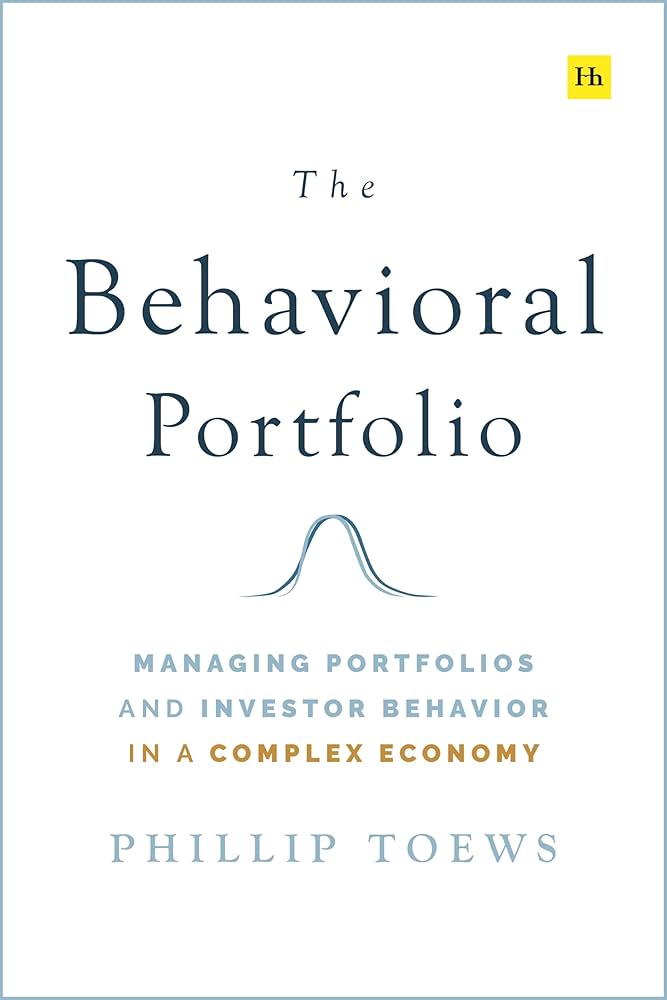
Review of The Behavioral Portfolio
The author wants to share new strategies that are being used by advisors to manage investor behaviour.
The Aim
An advisor’s job is to get your clients to their main goals on time with as much control as possible.
The target of advisors for investors should be steady return and peace of mind.
The Conventional Advice and Its Limitations
Portfolio diversification is effective at lowering risk during most markets but breaks down during extreme crises if we are limited to conventional asset classes (e.g. 60/40 stock/bond).
The concurrent decrease in value of bonds and stocks would occur if inflation soars and interest rates rise at the same time that the economy falters and stock prices plummet.
Rebalancing is ineffective at reducing risk and also increases investors’ exposure to depletion of capital during the worst that markets have to offer.
Redefining Risk
Volatility – the primary risk measure used by financial institutions – is blind to overvalued markets and fails to indicate the magnitude, frequency, or probability of losses.
Risk should be the probability of failing to meet life’s goals, ranging from not meeting aspirational goals to lowered living standards to becoming destitute. The biggest risk to investors is outliving their assets.
The Behavioral Portfolio
All advisors have the inherent conflict between the need to convey confidence about the potential for market growth and the need to inform investors about the possibility of severe market declines. The aim of behavioral portfolio is to provide investors with the safest, most consistent above-inflation growth possible.
The 6 criteria to consider when building behavioral portfolios are:
- Comprehensively address tail risk
- Provide long-range, above-inflation growth
- Capture gains during rising markets
- Preserve gains
- Attempt to maximise return consistency
- Include primarily reliable, understandable sources of growth and/or income
One of the best ways to destroy financial practice is missing out on gains that others are getting, or being wrong alone. Behavioral portfolios help to avoid this problem. The behavioral portfolio consists of 3 parts: conventional equity, hedged equity, and adaptive fixed income strategy.
Conclusion
The Behavioral Portfolio is a book for financial planners or advisors. The author begins with a common financial planning scenario between a planner and client, then proceeds to the basics of investment, comparing stocks and bonds, and finally giving a blueprint to construct the behavioral portfolios. All the recommendations are backed by statistics.
At first, I wanted to learn how to construct portfolios that earn money for investors even after fees. Nonetheless, the most important lesson for me is that advisors should be clients’ primary risk manager. Besides that, we should also be contrarian. As an example, when Chicago Board Options Exchange’s Volatility Index (VIX) was high, returns in S&P500 in the following year was surprisingly high.
Though it is a book for advisors and focuses on the US market, retail investors can adapt the lessons in this book and try to implement them to improve the odds of not outliving their money. Otherwise, you can just find a financial planner who can help you to implement this strategy.
One-sentence summary for The Behavioral Portfolio
Investors’ and advisors’ behaviours are an often overlooked determinant of the portfolios’ return.
Quotes
- Stocks are the engines of portfolio growth.
- Once markets reach a certain level of distress, investors leave advisors or leave the markets.
- Markets are unbounded. Stocks and bonds can lose all of their value.
- Once everyone in the market understands something to be true, and allocated on that belief, it is no longer true.
Rating
⭐⭐⭐
Interested in The Behavioral Portfolio?
You may get the book from through the links below*.
Get the print book from Shopee Malaysia here
Get the ebook from Shopee Malaysia here
*These are affiliate links and I might earn a small amount if you purchase the book through the links.